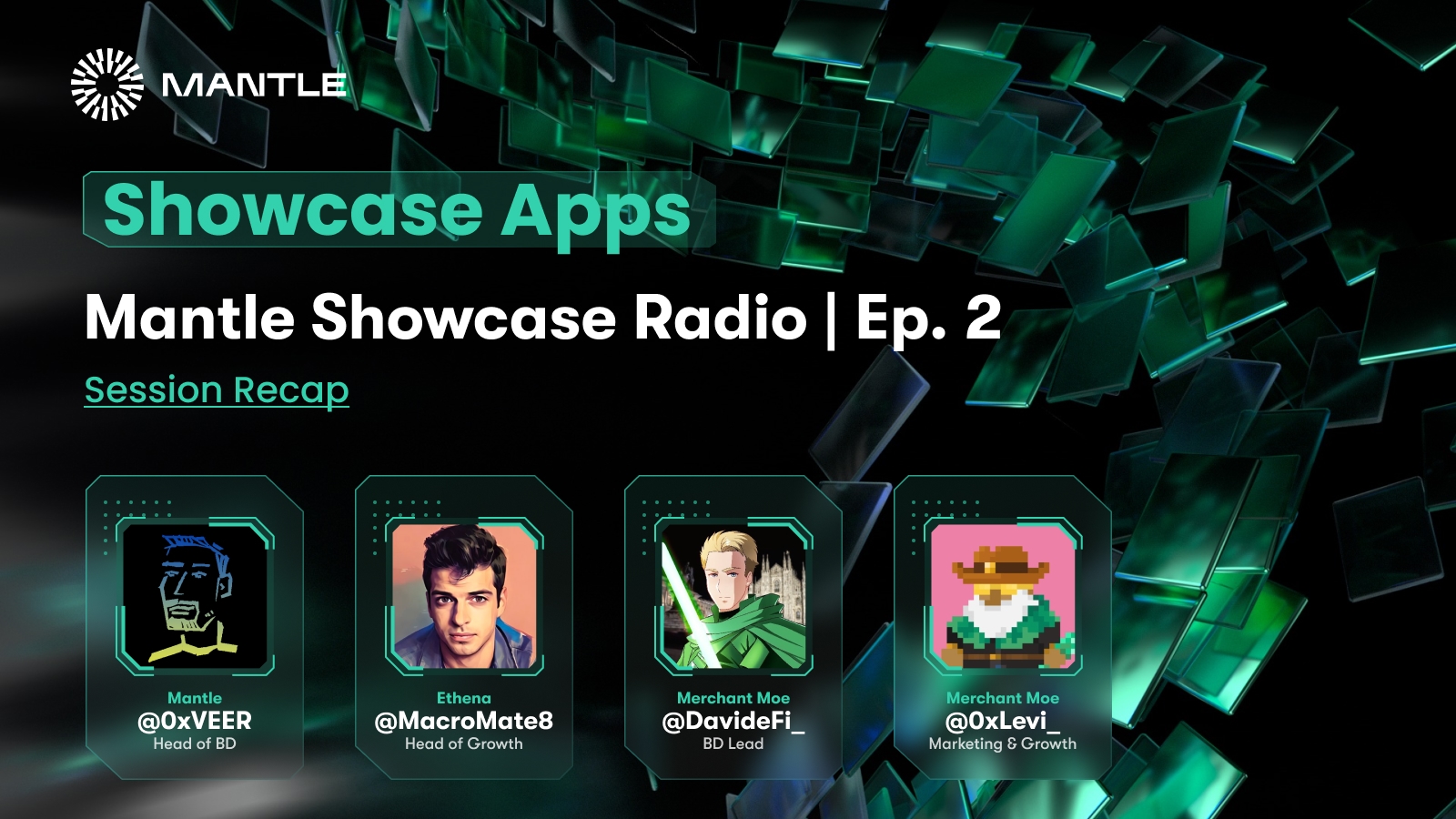
In this installment of Showcase Radio, Mark (@0xVEER) from Mantle hosts Levi (@MerchantMoe_xyz) and Davide (@DavideFi_) from the Merchant Moe team, along with Seraphim (@Seraphim), the head of growth at Ethena Labs. Both Merchant Moe and Ethena are a part of the Mantle Showcase Apps program, which is a great initiative to support the development of decentralized applications on the network.
Both of these projects, along with the decentralized finance (DeFi) space as a whole, are currently buzzing with exciting developments. Our guests will answer questions from both the community and Mark to offer valuable insights into these dynamic progressions.
Some sentences have been edited for clarity and brevity.
What is Ethena?
S: Simply put, it's a crypto native dollar that isn’t based on TradFi institutional payment rails like U.S. Treasuries. The yield is derived from crypto native sources like staking, namely ETH staking and perpetual futures (perp) basis, so it's a very capital efficient stablecoin, but arises yield from crypto native sources.
What is Merchant Moe building?
L: We're building the traders’ oasis for Mantle. We're planning on building the cornerstone decentralized exchange (DEX), which is going to be the central liquidity and trading hub of the ecosystem.
A DEX underpins everything. You need that liquidity layer to let everything run and some of the things that we excel at is making that DeFi experience super easy and accessible. Ultimately, our aim is to provide a market leading DEX experience to our users.
What unique contributions is Ethena bringing to the Mantle Ecosystem?
S: The first thing is the yield is not derived from Treasury rates. That's like a unique value prop. We're not like classic RWA, TradFi, Treasury kind of stablecoins.
Secondly, we are backed by crypto assets, but we're still capital efficient.
Finally, I think we are right in between centralized finance (CeFi) and DeFi. We are taking staked ETH as collateral. We're using institutional custody — which is on-chain, but still it's institutional — and we're shorting ETH perps on centralized exchanges like Bybit. So it's an interesting mix of CeFi and DeFi infrastructure with one product. I don't think it has been done before.
What is unique about Merchant Moe?
L: Merchant Moe is completely aligned with Mantle Ecosystem. From a branding perspective, from token incentives, from the tech community, everything that we're doing with Merchant Moe is built to not only be integrated within the Mantle community, but also to help it grow and that's one of the great benefits to us launching in this fashion.
But where our biggest innovation comes is with liquidity book. This is a whole new concentrated liquidity market maker protocol that enhances the trading experience completely. You have zero slippage trading, reduced costs for traders, and from a liquidity provision side it's significantly more capital efficient, more composable and a lot easier to run more custom strategies.
In addition to this, emissions of Moe is going to be run on community driven decision making and governance. If you have the $MOE token, you will stake it, and you'll accrue $veMOE, which is your voting power, and you'll get to vote to direct the emissions of $MOE into different pools. So instead of having the team decide where the emissions are going, it's going to be decided by the community.
Will Ethena launch a native token on Mantle?
S: We're actually working on the architecture of cross-chain deployment at the moment. Ethena is going to do something similar to what Lido is doing, where you can mint the token on mainnet, but then you can bridge it to Mantle.
How does Ethena aim to mitigate risks?
S: The first thing we did was hire Chaos Labs to produce research reports. We've done lots of internal papers on liquidity of perps, viability of staked ETH as collateral, liquidity across different venues, and suitability as collateral. If you look at the docs, it is some of the most comprehensive docs you've seen in DeFi.
There's also going to be an insurance fund, so if funding turns negative overall, it's going to be subsidized from the insurance funds as well.
Why should users diversify their stablecoin holdings?
S: The practical answer is for most people at some point — you're sitting on idle capital that does not earn any yield, and switching to USDe and staking it effectively allows you to earn substantial yields from the staking market and perp market.
If you have idle capital in USDT and USDC, it's a pretty good idea to probably diversify and earn some yield on that while it’s sitting there.
Why did Merchant Moe decide to work with Mantle?
D: We believe that the Mantle team just gets DeFi, and this is very important because a team that understands what a blockchain needs to distinguish themselves, is a chain that has the chance to make it and be noticed in the crowd of so many chains that all try to compete for the same audience.
We have always been very conservative in deciding on which blockchains to work with. To date we’ve only considered just a few. We bet on the best technology, run by the best team with the most interesting and most vibrant DeFi ecosystem.
Why did Ethena decide to work with Mantle?
S: The user base from Bybit is a great asset. The roadmap is pretty impressive as well. So we thought it just makes a lot of sense to create a yield ecosystem with Mantle. You guys have been doubling down on that with Lido, Ethena, and Ondo Finance. It seems like a good spot to build yield products.
Where should Mantle's strategic focus be right now?
S: I think 2023 has shown us that what people care about is yield. A lot of people are relocating from stables like USDT and USDC into yield-bearing opportunities. So, attracting projects that emphasize yields and scales of capital in liquid staking, re-staking, and delta-neutral stablecoins is an excellent direction to go as an ecosystem.
What’s on the Roadmap for Ethena in Q1 and Q2 of 2024?
S: The big focus now is raising TVL. After that, we're going to start a sharding campaign and a little bit of Alpha; there might be some points involved.
We just have to target the DeFi ecosystem with different communities like Synthetix, Lido, and Mantle. Then we'll go for CeFi wallets, like OKX web3 wallets. Bybit and Binance also have wallets. So, an extensive campaign to cover DeFi essentially with points and other tools.


